St. Louis Post-Dispatch • By John M. McGuire, Of the Post-Dispatch Staff
Young Businessman Is Thriving In Competition With 77 Firms
The head of Philibert Security Systems, a new burglary alarm company, is wrestling with some basic operational problems:
“When I get out of school I hope to get a decent car. I don’t have a desk yet, but I’m getting one. I am also getting my own business phone.”
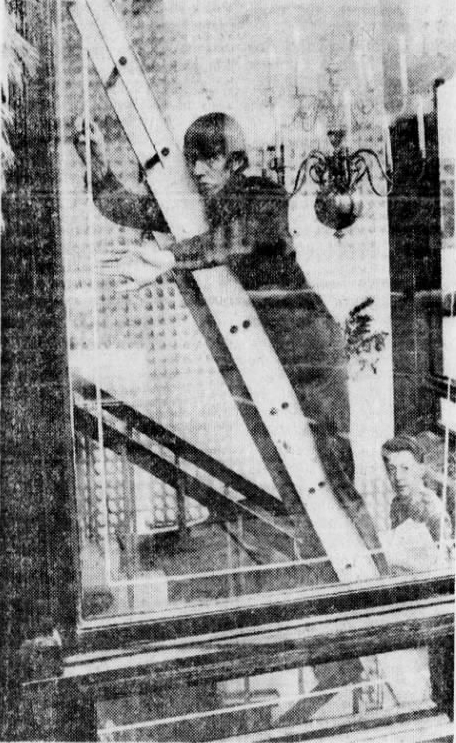
Benjamin W. Philibert, 18 years old, in his last year at Brentwood High School, talked about his new company from a ladder, as he applied sensitized metal foil, for an alarm system, to the windows of the fashionable Warfield Shops Inc., at the corner of Euclid and Maryland Avenues.
Benny, a name his mother still uses, has been in business for himself about three months, has had 10 customers and is guided by a simple business philosophy.
“If I don’t keep the price down, there’s no reason they should come to me.”
Then, stepping off the bottom rung of the ladder, he said with a bashful smile: “And as long as crime keeps going up as it is…”
Philibert has no plans for a major expansion of his small business (he said he doesn’t believe in borrowing money) after he graduates from high school this spring. He says it’s important to keep his overhead as low as possible. “I can’t get too costly. You know there are 77 listings (for burglary alarm companies) in the Yellow Pages right now.”
Ben Philibert operates the business from his bedroom in the family’s frame house on Hilldale Avenue, Brentwood.
His is a 24-hour operation. And when Philibert installs one of his high-priced alarms, an electrical warning system manufactured by Remote Control Devices of Maplewood, one of the five automatic dialing hookups goes into his home phone, in addition to the appropriate police department and the alarm owner. Such an alarm system costs about $550, he said.
If the alarm goes off, Philibert is called. He explained that 98 per cent of the time an alarm that is activated turns out to be a false alarm.
“People make mistakes and forget to turn it off in the morning,” he says. “Women usually are the ones. They’re afraid of alarms for some reason.”
Young Philibert’s interest in burglary alarms started before the rush for such devices was brought on by the law and order surge of the late 1960s.
At the age of 11, Philibert, through a trial and error process, made an alarm system for a small shed in the backyard of his home.
The shed serves as an antique storage room. Philibert collects antiques. He has a long-range plan to build an antique town, which he says would be an amusement attraction.
“I’ll build the town,” he says, “and have everything exactly as it was 100 years ago.”
But the homemade alarm on the backyard shed was the thing that started his fascination with burglary alarms.
Before he went on his own, Philibert worked for $1.55 an hour for the Automatic Fire and Burglar Control Corp. He was hired as a part-time worker, mostly to mop floors, he says.
He got his first break as a burglary alarm installer when the regular installers refused to work in apartment projects in high crime areas.
“They all chickened out,” he recalls, “so I went and installed the things.
“Then I told myself, if I can do it here I can do it on my own. So I did.”
His first jobs were household alarm systems in north St. Louis. The customers were pleased with both the alarms and the price, and word about Philibert Security Systems spread.
He has installed other alarm systems in expensive shops in the Maryland Plaza area. From his ladder in the Warfield Shops, Philibert pointed to the north and east as he talked about other possible jobs. At this point, his fledgling company relies almost entirely on referrals.
Philibert is hopeful that his father, who is a paint salesman, will help him with bookkeeping and sales when the father retires.
“I wanted to take bookkeeping in school,” he said, “but they (school counselors) said it would be too hard… That’s a laugh, I’m going to have to keep my own books.”
Philibert has a strong dislike of school (“I’ve hated it since kindergarten”) and never planned to go to college. “I don’t do too well in school… I’m not college material I guess you could say.”
Philibert, who is six feet, four inches tall, once considered going out for the Brentwood basketball team, with strong urgings from his parents and the high school basketball coach.
“But it seemed like such a waste,” he said. “There was really nothing in it for me. I might have gotten a scholarship to college… but then I’m not interested in college.”
“He was just not willing to take the time out,” said his mother. “But he always had a kind of drive, a curiosity, especially in electricity.”
In a final expression of maternal approbation, Mrs. Philibert added: “You read so much about kids who drop out… I think teen-agers above all need this, because a lot of them are in there pitching… Benny is one of them.”